
Higgsfield Vibe-Motion: The AI Tool Motion Designers Are Worried About

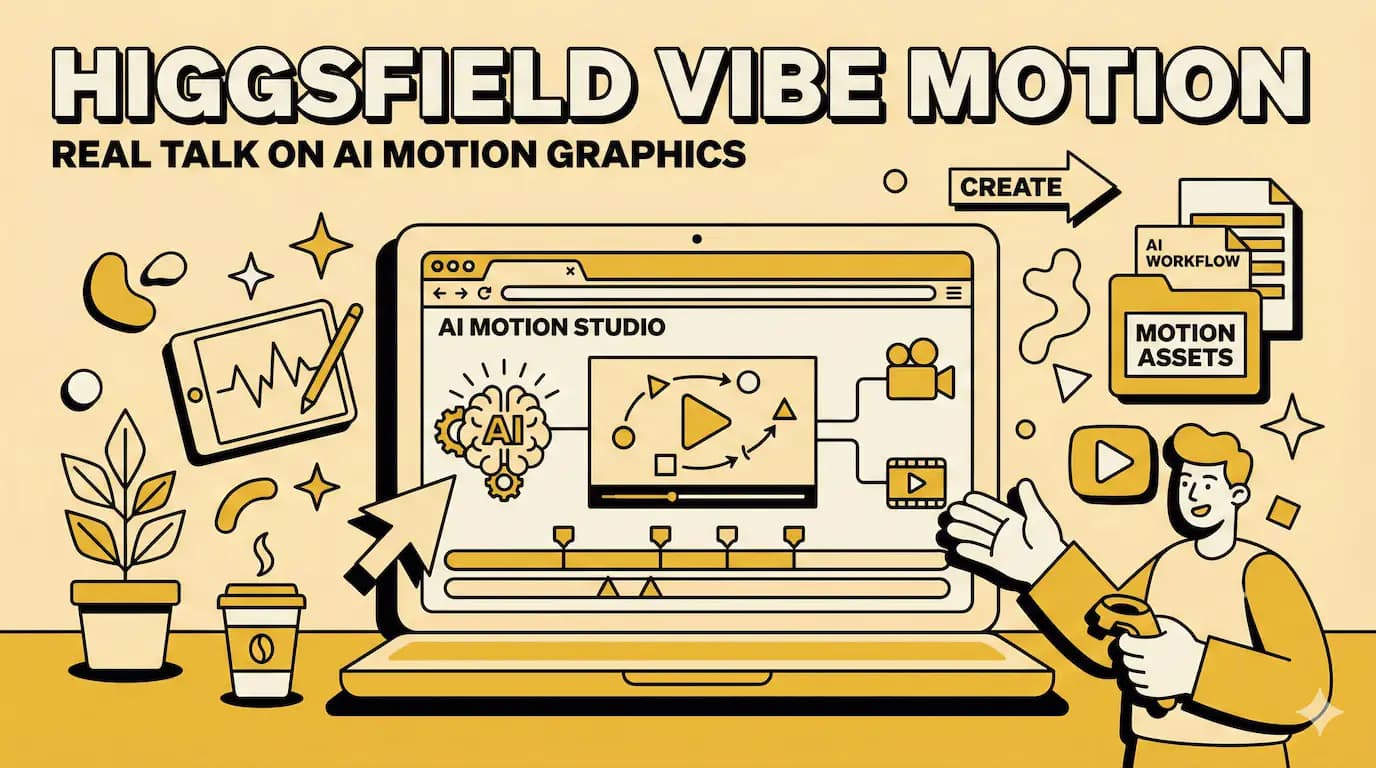
A motion designer on Reddit posted this week: "It's just PowerPoint with default animations." He was talking about Higgsfield's new Vibe-Motion feature. The post got 108 upvotes. Another commenter replied: "Everyone's job is safe, lol".
But here's the thing. The same week, a developer named Rohan Paul said it would "hit ad agency workflows hard". His post got shared everywhere. He called it a turning point for motion design.
So which is it? Is this tool trash or is it the end of After Effects?
i spent two hours trying to figure that out. Watched the tutorials. Read the Reddit threads. Tried to understand what makes this different from the fifty other AI video tools that launched this month.
You're probably here because you saw the hype. Or maybe you're a motion designer who's tired of hearing about AI taking your job. Either way, you want to know if this is real.
What Vibe-Motion actually does
It creates motion graphics from text prompts. That's it. You type "3D isometric floating electronics with neon glow" and it generates an animation.
No timelines. No keyframes. No After Effects.
The twist is it runs on Claude's reasoning engine. Not some video diffusion model. That matters because motion design isn't about visuals. It's about rules.
When you animate text in After Effects, you're setting easing curves. Timing offsets. Rotation values. You're not painting pixels. You're defining behavior.
Claude understands rules better than it understands pixels.
i used to think all AI video tools were the same. Type a prompt, wait three minutes, get something that looks vaguely like what you asked for. But motion graphics are different. They need precision.
The first time i saw the demo, i was skeptical. It looked too clean. Too perfect. Like someone just made it in After Effects and called it AI.
Turns out that's exactly what people think. One Reddit user said: "I wouldn't be surprised if this video wasn't actually made by their AI".
The real-time canvas problem
Here's what people keep missing. Vibe-Motion has a real-time canvas.
You don't just prompt and pray. You tweak things live. Adjust the "vibe." Change motion layers. See updates instantly.
Rohan Paul described it as "closer to directing than prompting".
That's the part that matters. Most AI tools give you one shot. You prompt, it generates, you're stuck with the result. This one lets you iterate.
But does that make it good? Not necessarily.
My coworker tried it for a client project. Said the output looked "like a PowerPoint presentation". Spent more time fixing it than he would have in After Effects.
The problem isn't what you think. It's not that the AI can't understand motion. It's that motion design is taste. And taste is hard to prompt.
What actually happens when you use it
You open the Higgsfield workspace. Select the Vibe-Motion workflow. Type your prompt.
Claude handles the motion logic. You click generate.
Then you wait. And what comes back is... fine. Not terrible. Not amazing. Just fine.
The text doesn't break. That's actually impressive. Most AI tools scramble text like it's a captcha.
The animations are deterministic. Same prompt gives you the same result every time. That matters for client revisions.
And you can layer motion effects on existing videos.
But it still looks like AI made it.
Most tutorials tell you this is perfect for social media ads. YouTube intros. Viral content. They're not wrong. It works for that.
What they don't tell you is that professional motion designers can spot AI motion in two seconds. The easing is off. The timing feels generic. The whole thing lacks personality.
i spent an hour trying to make something that didn't look AI-generated. Couldn't do it. The tool has a look. And once you see it, you can't unsee it.
Why motion designers are actually worried
Not because the tool is good. Because their clients think it's good enough.
A 30-second After Effects animation might cost $2,000. Vibe-Motion costs whatever Higgsfield charges per month. For a startup with no budget, that math works.
And the thing is, most clients can't tell the difference. They see motion. They see their logo animating. They're happy.
Motion design has always been about speed vs quality. How fast can you deliver something that looks professional? This tool shifts that equation.
You can generate a draft in three minutes. Tweak it for another ten. Export and move on.
For freelancers charging by the project, that's terrifying. For agencies billing by the hour, it's worse.
But here's the real question people always ask: will this replace motion designers?
No. But it will replace motion designers who only know how to make logo stings and text animations. The baseline stuff. The work that clients tolerate but don't love.
If your entire skill set is animating text on a screen, yeah. You should be worried.
The naming thing
This has nothing to do with motion graphics. But i need to talk about it.
Why is it called Vibe-Motion? What does that mean?
The entire AI industry has this problem. Every tool name sounds like a startup that got named by a random word generator. Vibe-Motion. Popcorn. DoP I2V-01.
i get that naming is hard. But come on. "Vibe-Motion" sounds like a massage chair feature.
My theory is that marketing teams are so worried about sounding too technical that they go the opposite direction. They pick words that sound friendly. Approachable. Human.
The result is tools that sound like they were designed for a different product. Motion design is precise. Technical. Unforgiving. And the tool that's supposed to change it is called "Vibe-Motion."
Maybe that's the point. Maybe they want it to feel accessible. Less intimidating than After Effects.
Or maybe they just couldn't get the domain they wanted.
The honest part
Most people don't need this.
If you're a professional motion designer, you're faster in After Effects. You have muscle memory. You know the shortcuts. You can execute an idea in the time it takes to write a good prompt.
If you're a complete beginner, this might feel easier. But you're still going to hit a ceiling. The tool can only do what it's trained to do. And motion design is about breaking rules, not following them.
The sweet spot is small businesses and solo creators who need quick, decent-looking animations for social content. People who would have hired a freelancer on Fiverr for $50. Now they can do it themselves.
That's not nothing. But it's not the end of motion design either.
The biggest misconception is that AI tools make professionals obsolete. They don't. They make mediocre work cheaper.
And if your work is mediocre, that's a you problem, not an AI problem.
This is overkill for most use cases.
Unless you're pumping out dozens of social ads every week, you probably don't need a subscription to another AI tool. You need to get better at the tools you already have.
i keep thinking about that Reddit comment. The one that said everyone's job is safe.
He's probably right. Not because the tool is bad. But because motion design was never just about making things move.
It's about timing. Rhythm. The feeling you get when an animation lands exactly right.
You can't prompt that. Not yet, anyway.
And until you can, motion designers still have a reason to show up.
Enjoyed this article? Check out more posts.
View All Posts