
India Blocked Supabase. Your App Is Down. Now What?

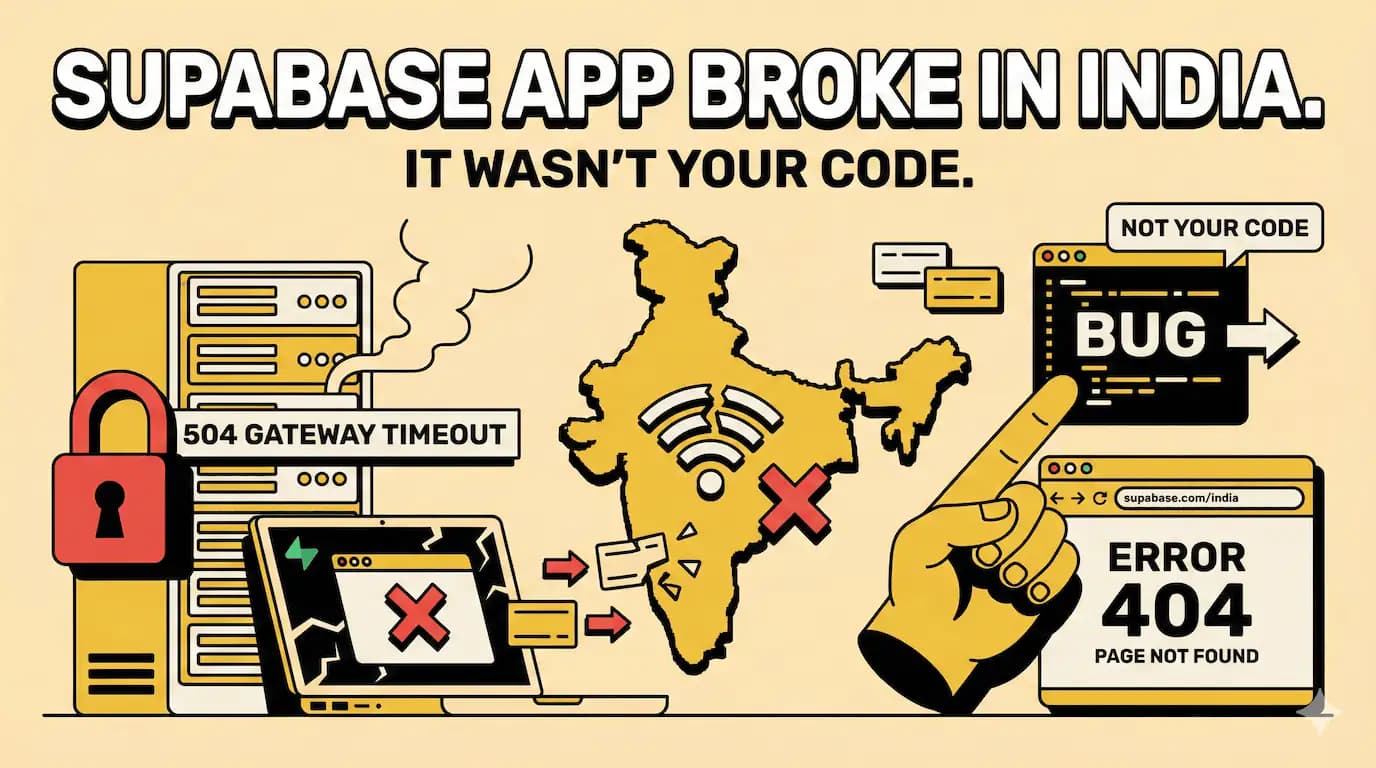
Developers across India hit connection timeouts on February 24, 2026. No warning. No email. Just requests hanging and nothing coming back.
Someone on Reddit posted a PSA almost immediately. "Connection timeouts in India may NOT be your fault." That thread spread fast. Because it wasn't a Supabase outage. It was a government order.
India blocked Supabase. Not the marketing website. The actual infrastructure. APIs, authentication, storage, realtime endpoints. All of it, gone overnight for millions of users.
India is Supabase's fourth largest market. Nine percent of global traffic. Around 365,000 visits in January 2026, up 179% year over year. A massive developer community. Cut off without a single public explanation.
If you had a production app on Supabase, you know what this meant. Your users hit blank screens. Your auth flows broke. Database calls timed out silently. And for hours, you had no idea why.
i checked my own projects immediately. You probably did too.
The actual mechanics of the block
The order came under Section 69A of India's Information Technology Act. The same law that blocked TikTok, PUBG, and WeChat.
ISPs got the directive on February 24. Jio moved first. Then Airtel. Then ACT Fibernet.
Here's what confused everyone at first. Supabase's main website still loaded. You could browse docs. Log into the dashboard. But the moment your app tried to call an API? Timeout.
What got blocked was the project infrastructure. The domains that look like abcdefghijklmnopqrst.supabase.co. Your API calls go there. Auth tokens resolve there. Storage requests go there. The block hit exactly that.
Developers pieced this together on Reddit in real time. First everyone assumed a Supabase outage. Then people noticed VPNs fixed it instantly. Then someone identified DNS-level blocking. Then TechCrunch confirmed a blocking order.
Production apps went down. Nobody got a notification.
Why nobody knows the reason
Section 69A doesn't require the government to explain itself. They issue the order. ISPs comply. That's it.
No press release. No official statement. No email to Supabase explaining what triggered it.
The most common theory is that some app built on Supabase's shared infrastructure got flagged. Maybe a security concern, maybe content. But instead of blocking that one app, the order hit the whole platform domain.
One digital rights advocate put it plainly: you cannot determine where it is safe to launch projects to evade blocks. And suddenly you may find yourself needing to seek an alternative.
That's not unique to Supabase. Any backend-as-a-service running shared domains in India faces this. If the government targets the domain, every app on it goes down together.
What Supabase actually did
Supabase posted on X tagging Ashwini Vaishnaw, India's IT minister. Said millions of Indian users couldn't access the platform. Asked for a conversation.
Then deleted the post.
Their official statement after: "We recognize that numerous users in India remain unable to access Supabase. We understand the challenges this poses for our users in that region. Supabase is actively communicating through all available avenues."
Careful language. Which usually means working channels they can't discuss publicly.
And no response from the Ministry of Electronics and Information Technology as of late February 2026. No reason. No timeline.
Industry analysts noted something worse. No new registrations from India in recent days. Existing developers scrambling to fix live apps. New developers not even trying to sign up.
What actually helps
Here's what works and what doesn't:
Change DNS to 1.1.1.1: Fixes the issue for some ISPs. Mostly doesn't work for Jio.
VPN: Works perfectly for your own development. Your users can't use a VPN.
Custom domain via Cloudflare: Point
api.yourdomain.comto your Supabase project via CNAME. Keep DNS on Cloudflare. ISP DNS never sees supabase.co.Cloudflare Workers proxy: More setup. Routes your API traffic through Workers endpoints. Survives ISP-level blocks.
The custom domain approach is cleanest. Supabase supports it natively. You add a CNAME record, verify the domain, and your endpoints move to something you control. Takes about 20 minutes if you know what you're doing.
But it requires the Pro plan on Supabase. It requires owning a domain. And it requires having this set up before the block happened. If you didn't, your app was broken before you even woke up that morning.
i find it genuinely annoying that the cleanest fix to a government block is something you needed to configure weeks in advance.
A small thing about free tiers
Here's something not directly about the block but it keeps sitting in my head.
A huge number of developers in India build on free tiers. And Supabase's free tier is actually good. Postgres, auth, storage, edge functions. All free. That's part of why 365,000 developers were on it in January.
But there's a quiet trap. Free infrastructure lowers the barrier to build. It also lowers the barrier to lose everything overnight. You build fast. You skip the fallback planning. Because nothing bad has happened yet.
This isn't Supabase's fault. It's not a free tier problem. It's just how people build. i've done it. Most developers have.
There's always something in your stack you don't fully control. Most of the time it doesn't matter. And then one morning it matters a lot.
The honest part
Most of the suggested fixes are annoying to implement on existing apps. Custom domains are great if you planned ahead. They're painful to retrofit into a production app with real users and live auth flows.
Cloudflare Workers as a proxy is technically sound. But it adds latency, cost, and another layer to maintain and debug.
Self-hosting Supabase on your own VPS keeps coming up in threads. But self-hosting a production Supabase setup with proper backups, security, and uptime is hard. Most teams that try it are looking for alternatives within six months.
The uncomfortable truth: there is no clean answer right now. You're choosing between annoying options. Some cheaper. Some more reliable. None of them feel good.
And the government still hasn't said why.
A developer on r/developersIndia asked a simple question. "Does anyone have information on why this is happening?"
Nobody had a solid answer. Just speculation. Just workarounds. Just developers helping each other patch things at 2am.
That thread is still getting new comments.
i think about that whenever i pick infrastructure for a new project now. Not just performance. Not just cost. But: what happens if this stops working tomorrow? Not because of a bug. Because of a decision made in a room i have no access to.
Annoying question to carry. But a real one.
Enjoyed this article? Check out more posts.
View All Posts