
Claude Opus 4.6 vs Codex 5.3: Which AI Wins for Developers

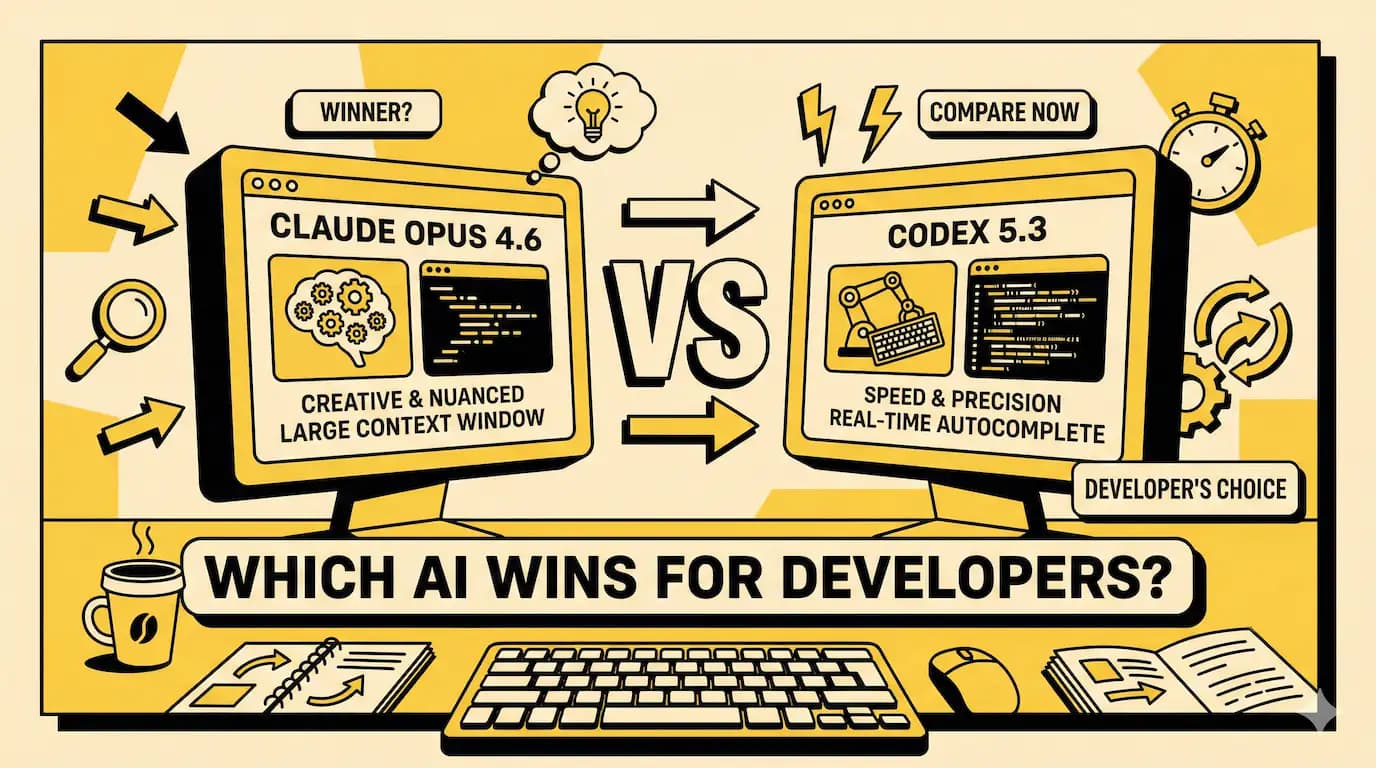
Anthropic dropped Claude Opus 4.6 on February 5th at 9:45 AM PST. OpenAI responded 15 minutes later with GPT-5.3 Codex. Both companies had planned a coordinated 10 AM launch, but Anthropic jumped early. Within an hour, Reddit lit up with developers testing both models. The reactions weren't what either company hoped for.
The drama started Monday when OpenAI launched Codex as an agentic coding tool. By Thursday morning, they had GPT-5.3 ready to ship. Anthropic couldn't wait. They moved their launch 15 minutes early, forcing OpenAI's hand. This matters because developers were refreshing their browsers waiting to see which model would actually ship first. The AI coding wars just got personal.
what the benchmarks say
Claude Opus 4.6 scores 80.9% on SWE-bench, while GPT-5.2 Codex (the previous version) hit 80.0%. That's basically tied. But Codex dominates on SWE-bench Pro with 56.4% compared to Opus 4.5's lower performance. The new 5.3 version is 25% faster than 5.2.
Here's what broke in real testing. A developer tried implementing an AI-powered task description generator with caching. Opus 4.5 took 8 minutes and produced partially working code. The UI didn't break when AI was unavailable, but the cache implementation was incomplete. Codex finished in 7.5 minutes with cleaner code. It didn't run. API version conflicts and unexported code references killed it.
Opus produced code that compiled but didn't fully work. Codex produced code that didn't compile at all.
i've hit this exact problem. You ask for something complex, Codex gives you perfect logic with zero consideration for your actual environment. Opus gives you defensive code that handles edge cases but feels bloated.
the token problem nobody expected
One user on the Pro plan burned through half their 5-hour window in 30 minutes using Opus 4.6. Same projects. Same prompts as Opus 4.5. Never had this issue before.
Another developer started getting "response could not be fully generated" errors within minutes of launch. The context compaction bugs from previous versions are back. This is annoying because Anthropic specifically said Opus 4.6 handles large codebases better.
The Reddit comment that summarized it best: "message exceeds length limit" errors are hitting everyone. You're not alone if you're seeing this. The model is technically better at reasoning but chokes on its own verbosity.
what they're actually good at
Opus 4.6 writes code that reads like a senior engineer reviewed it. Clean structure. Thoughtful comments. Handles edge cases you didn't ask for. The problem is it takes forever and uses more tokens than your budget allows.
Codex 5.3 moves fast. It's 30-40% quicker than Opus on implementation speed. The code is terse, focused, and occasionally breaks because it assumed your environment matches its training data. Integration testing is where it shines - it generates code that fits existing APIs cleanly.
A Reddit user who tested both said "codex imo is far better. Opus is only good when you give it a big issue to solve. Codex with a single problem is far better imo".
recursive development
GPT-5.3 Codex was built by debugging itself. OpenAI's engineers used early versions of the model to evaluate its own performance and fix bugs. That's wild. The model that writes code also fixed the code that makes it write code.
This explains why Codex is better at catching integration bugs. It learned by catching its own mistakes during training. Opus learned by reading every GitHub repo ever. Different approaches.
why this launch felt weird
Most AI launches happen in isolation. You get a blog post, some benchmarks, maybe a demo. This one was different. Both companies coordinated a release time, then immediately broke coordination. Anthropic moved 15 minutes early. OpenAI scrambled to respond.
It felt like watching two startups fight over a Product Hunt launch slot. Except these companies have billions in funding and millions of users. The pettiness was refreshing.
the naming mess
Can we talk about how confusing these names are? Claude Opus 4.6. GPT-5.3 Codex. What happened to simple version numbers?
i still don't know if "Codex" means the tool or the model. OpenAI uses it for both. Anthropic at least keeps "Opus" as the model tier and "Claude" as the product. But then you have Sonnet 4.5 and Opus 4.6 and now i need a spreadsheet to track which number means what.
My coworker asked me yesterday: "Is Codex 5.3 better than Claude 4.6?" The version numbers don't map. You can't compare them directly. It's like asking if iOS 17 is better than Windows 11. The numbers are arbitrary marketing decisions.
This matters because developers make decisions based on these names. When you see "5.3" next to "4.6," your brain assumes 5.3 is newer or better. It's not. They're just different companies with different numbering schemes. The whole thing is designed to confuse procurement teams.
the honest take
Most people don't need either of these yet. If you're building simple CRUD apps or debugging basic JavaScript, GPT-4 or Claude Sonnet still work fine. These new models are overkill.
Opus 4.6 is for teams with complex codebases who value maintainability over speed. You'll burn through tokens fast, but the code quality is higher. Codex 5.3 is for solo developers or small teams moving fast and willing to debug integration issues.
The real problem isn't which model is better. It's that both launched broken. Token limits on Opus. Integration bugs on Codex. Reddit is full of developers hitting walls within hours of release.
If you're on a free tier, wait a week. Let the early adopters find the bugs. If you're paying for Pro, maybe stick with the previous version until the hotfixes ship. Neither model is production-ready despite what the blog posts claim.
what this means for you
Pick based on your workflow. If you work in sessions, explaining your codebase in detail and expecting thoughtful architectural decisions, try Opus. If you want fast iteration with less handholding, Codex is cleaner.
i tested Opus 4.6 for about an hour yesterday. Burned through my usage limit by lunchtime. The code it wrote was good, but i couldn't finish my project because the context window kept maxing out. That's the real story. Not the benchmarks. Not the launch drama. Just a model that works until it doesn't.
Both companies will patch these issues. They always do. But right now, on February 6th 2026, the choice isn't clear. It's just two flawed tools fighting for attention while developers try to ship actual products.
Enjoyed this article? Check out more posts.
View All Posts