
I Tested 3 AI Agent Frameworks. Here's What Broke

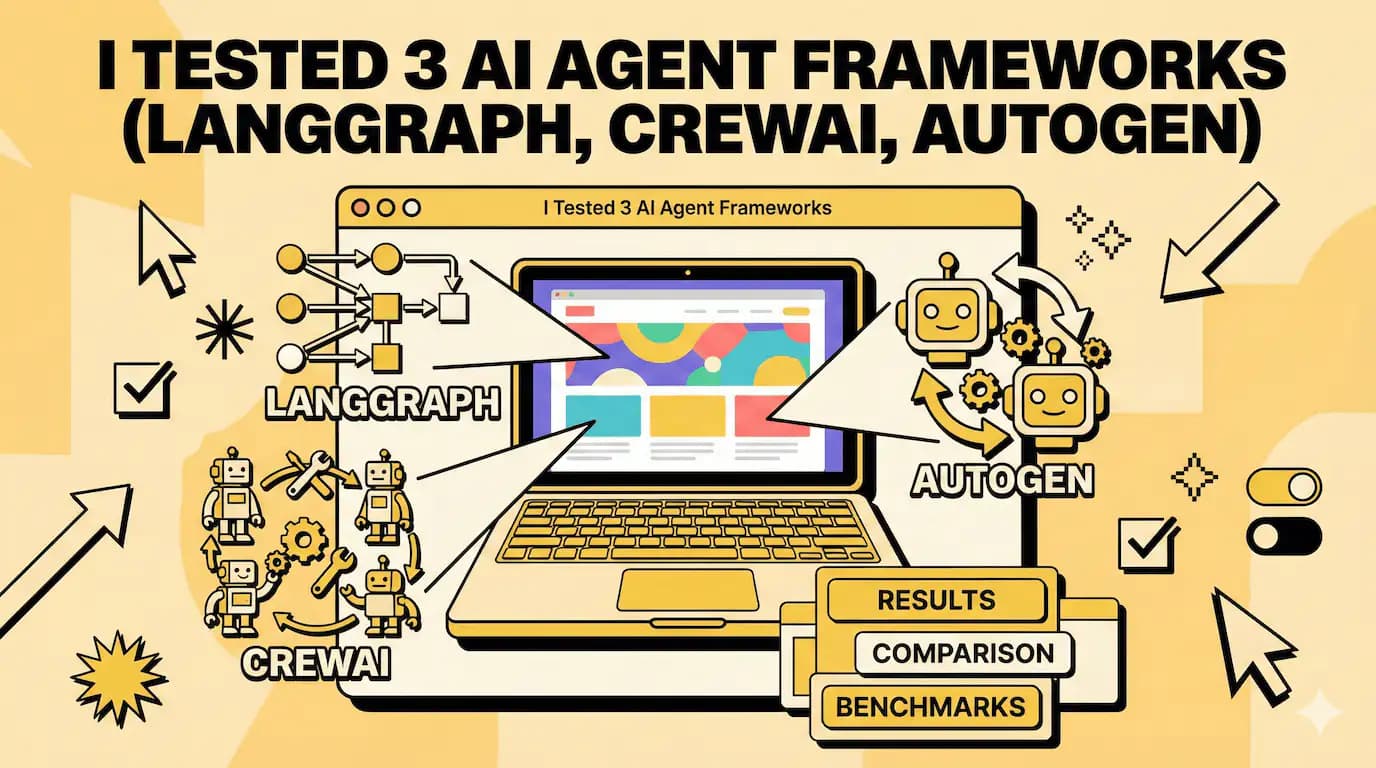
A developer on Reddit last week posted something that stuck with me. They'd tried AutoGen first. Found it smooth and easy. Then switched to LangGraph for "flexibility." Spent two weeks just understanding state management. Their exact words: "AutoGen provides a very smooth learning curve... but it lacks flexibility".
Everyone building AI agents hits this wall. You start with excitement. Pick a framework. Then realize you chose wrong. Or maybe you chose right. But you won't know until you've wasted weeks rebuilding.
The agentic AI space exploded in 2025. LangChain, LangGraph, AutoGen, CrewAI, PydanticAI, Smolagents. The list keeps growing. And every framework promises the same thing. Easy agent building. Production ready. Powerful and flexible.
They can't all be right.
i spent january testing these frameworks for my own project. Built the same agent three different ways. Here's what actually matters when you're choosing. Not the marketing pages. Not the GitHub stars. The stuff that breaks at 2am when your agent won't stop calling the wrong tool.
The big three everyone talks about
LangGraph sits at the top of most lists. It's part of the LangChain ecosystem. Over 90,000 GitHub stars on LangChain alone. The framework treats agents as nodes in a graph. State flows between them. Conditional branches. Event-driven execution.
Sounds great in theory.
In practice, one developer described it as having "one of the steepest learning curves" they'd experienced in years. The basics? Easy enough. But production-grade applications? That's where it gets messy. You need to understand state management. Graph logic. Multi-agent orchestration. And the documentation feels like it's written for terminal users, not developers building real apps.
But if you figure it out, you get full control.
LangGraph excels when complexity is high. When you need debugging tools. Persistence layers. Human-in-the-loop workflows. When your workflow has fifteen steps and seven decision points. That's when the pain of learning pays off.
CrewAI went the opposite direction. Quick deployment. Template-driven workflows. Lightweight setup. A developer on Reddit called it the best bet if "you're aiming for a quick start". Good documentation. Lots of examples. Strong community.
It's role-based. Each agent gets a defined responsibility. Like a structured team environment. You assign tasks. The agents collaborate. It feels organized.
Best for startups and small teams running fast experiments. When speed and iteration matter more than custom orchestration. But you trade control for convenience. Some developers noted it gives you less oversight over agent pipelines compared to frameworks like PydanticAI.
What about AutoGen
Microsoft merged AutoGen and Semantic Kernel into a unified framework in 2026. It's the dominant choice for Azure-heavy enterprises now. Built on an Actor Model. Agents communicate asynchronously across different servers.
The standout feature? Magentic-One Architecture. A lead Orchestrator guides specialist agents. WebSurfer. Coder. FileSurfer. They work toward complex goals together.
AutoGen excels at autonomous code generation. Agents can self-correct. Rewrite. Execute. Great for programming challenges. And the learning curve is smooth. Easy to get started.
But it lacks flexibility. And scalability can be an issue as projects grow. One Reddit thread summed it up: "AutoGen is great for user-friendliness" but when it comes to scaling, LangGraph wins.
Here's what broke for me: i built a simple web scraping agent with AutoGen. Worked fine for three sites. Added a fourth site with dynamic content. The agent couldn't adapt without rewriting the whole flow. Switched to LangGraph. Took me four days to rebuild what took two hours in AutoGen.
Four days for flexibility i might never use.
The quieter options worth knowing
PydanticAI keeps showing up in Reddit threads. One developer said it's "the first framework I've used without encountering any limitations" after trying AutoGen, Semantic Kernel, Smolagents, and Agno.
It's built around structured input and output. Solid programming principles. Lightweight. The Pydantic-based toolset integrates with any LLM. Code stays clean. And developers praise the experience and documentation.
What makes it different: you get complete control over agent pipelines. That matters when clients need oversight. One user even combines it with LangGraph. "PydanticAI is better designed for Agents. But the graph does make more sense with langgraph".
Then there's Smolagents. A team tested eight agentic frameworks. Built the same system in each one. Smolagents won for ease of use. "By far the easiest to set up".
Writing with Smolagents feels like writing in pure Python. It abstracts just enough repetition. Tools are defined with @tools. Orchestration feels intuitive. No fighting the framework.
Why we name everything after animals
Someone on a developer forum once joked that half the AI tools sound like rejected Pokemon. Smolagents. LlamaIndex. CrewAI could be a water type.
It's not just AI. Look at software in general. Go. Rust. Python. We've been doing this forever. i think it's because technical names sound boring. "Multi-Agent Orchestration Framework 2.0" makes people's eyes glaze over.
But "Swarm"? That sticks. You remember it. You talk about it at lunch. "Yeah i'm using Swarm for my agents." Sounds cooler than "i'm using OpenAI's lightweight multi-agent coordination library."
My team named our internal tool "Platypus." No reason. Just liked the word. Three months later, someone from another department asked about "that platypus thing." Wouldn't have happened if we called it "Internal Agent Router v3."
Names matter more than we admit.
The production problem no one talks about
Most framework comparisons skip the hard part. They show you features. Integrations. How easy it is to get started.
They don't tell you that tuning and production live in separate worlds.
LangGraph and AutoGen are production-ready. But they lack automatic specialization. No in-context learning. No prompt tuning support. You want to optimize your agent based on real observations? You need DSPy or SynalFlow. But those frameworks lack the production ecosystems.
You're stuck choosing between stability and flexibility.
Teams end up in manual trial-and-error tuning cycles. You deploy. It breaks. You guess at fixes. Deploy again. Repeat. There's no clear path to bridge the gap.
And debugging? That's its own nightmare. Errors cascade through multi-agent systems. A mistake in task decomposition ripples everywhere. Hierarchical planning makes isolating problems nearly impossible.
One research study found developers struggle with understanding long, multi-turn agent conversations. Current tools lack interactive debugging support. You can't step through agent messages like normal code.
Most people don't need this complexity. If you're building a simple chatbot, use OpenAI's API directly. If you need basic automation, n8n works fine. Agentic frameworks are overkill for anything that doesn't require actual autonomous decision-making.
What i should have known
i picked LangGraph first. Because it had the most GitHub stars. Because everyone said it was powerful.
Spent two weeks reading documentation that assumed i already understood state graphs. Built three failed prototypes. Got frustrated. Switched to CrewAI. Had a working agent in four hours.
Then hit limitations. Needed custom tool orchestration CrewAI couldn't handle. Back to LangGraph. This time it made sense. Because i'd already built the simple version.
Start simple. Graduate to complex.
Most developers do it backwards. They pick the most powerful framework first. Then get buried in concepts they don't need yet. Build with CrewAI or Smolagents. Ship something. When you hit real limitations, you'll know exactly what you need from LangGraph or PydanticAI.
And if you're on Azure, just use the Microsoft framework. Fighting your infrastructure is worse than learning a new framework.
Still think about those two weeks. Could have shipped faster. But at least i understand state graphs now. That's worth something. Maybe.
Enjoyed this article? Check out more posts.
View All Posts